Vascular testing for nephrology practices means testing patients with chronic kidney disease (CKD), when clinically indicated, for peripheral arterial disease (PAD) and cardiovascular autonomic dysfunction inside your own office, usually in about 7 to 10 minutes and without a needle. CKD and dialysis patients carry an outsized burden of vascular and nerve complications, and objective evaluation is warranted when symptoms or signs are documented. A non-invasive, point-of-care system such as the CMAT Advantage™, which is built on FDA-cleared component devices, lets a nephrology team measure the ankle-brachial index (ABI), the toe-brachial index (TBI), heart rate variability (HRV), and related markers at the bedside, then hand the nephrologist an objective report to act on. This guide explains why in-office testing belongs in nephrology, what the panel measures, how it fits a clinic visit, and how to add it.
What is vascular testing for nephrology practices?
Vascular testing for nephrology practices is a non-invasive way to assess blood flow and autonomic nerve function in high-risk kidney patients at the point of care, rather than referring every patient out for separate studies. Systems in this category, including the CMAT Advantage system, use blood-pressure cuffs and surface sensors to record several measurements in a single session. Typical outputs include ABI and TBI for arterial assessment, volume plethysmography waveforms, HRV, Ewing autonomic tests, and sudomotor (sweat-gland) responses.
For a nephrology practice, that combination matters. The same patients who need careful fluid and blood-pressure management are also the patients most likely to have arterial disease and autonomic dysfunction. Adding a structured vascular testing overview to the visit turns a hunch into documented, objective data.
Why do nephrology practices need in-office vascular testing?
Patients with chronic kidney disease sit at the intersection of nearly every risk factor for vascular disease: diabetes, hypertension, dyslipidemia, chronic inflammation, and mineral-bone disorder. Peripheral arterial disease affects roughly 12% to 38% of people with CKD or on dialysis, compared with about 4% of the general adult population. Cardiovascular disease is also the leading driver of mortality in this group, accounting for well over half of deaths among hemodialysis patients with a known cause.
In this group, objective testing is ordered when symptoms or signs are documented. It helps a nephrology team document arterial disease, protect feet, and coordinate referrals to vascular specialists or podiatry. It also complements the foot-risk assessment that diabetic CKD patients already need (see the diabetic foot exam workflow).
Why is the ankle-brachial index unreliable in dialysis patients?
This is the detail that makes vascular assessment in kidney patients different from a standard test. Advanced CKD and dialysis drive medial arterial calcification, which stiffens the ankle arteries and makes them resistant to compression. The result is an ankle-brachial index that reads falsely normal or even falsely high, so a real blockage can hide behind a reassuring number. Calcified vessels can produce a falsely elevated ABI above 1.40 even when significant disease is present on imaging. Because this false-negative pattern is so common in kidney disease, a KDIGO consensus report on arterial disease in CKD advocates measuring the toe-brachial index alongside the ABI in these patients.
Because toe arteries are far less affected by medial calcification, the toe-brachial index is the recommended fallback when the ABI is high or non-compressible. A toe-brachial index of 0.70 or lower is generally considered abnormal. A system that captures both ABI and TBI in one sitting means the nephrology team is not stuck with a single unreliable value. That is why a normal ABI alone should not close the book on a dialysis patient with warning signs.
| Measurement | What it assesses | Why it matters in CKD |
|---|---|---|
| Ankle-brachial index (ABI) | Ratio of ankle to arm systolic pressure | PAD assessment; a value of 0.90 or lower flags disease, while a value above 1.40 signals non-compressible calcified vessels |
| Toe-brachial index (TBI) | Toe-to-arm systolic pressure ratio | Stays reliable when ankle arteries are calcified; a value of 0.70 or lower suggests PAD, so it rescues the assessment ABI can miss |
| Heart rate variability (HRV) | Beat-to-beat cardiac autonomic balance | Reduced variability is associated with autonomic dysfunction and cardiovascular risk in dialysis patients |
| Sudomotor / galvanic skin response | Small-fiber and sweat-gland (autonomic) function | Helps flag the autonomic and peripheral nerve involvement common in uremia and diabetes |
| Volume plethysmography | Pulse-volume waveforms at the measured levels | Adds waveform detail to the overall vascular picture |

What are the benefits of vascular testing for nephrology practices?
The benefits of vascular testing for nephrology practices reach past a single number on a chart. Here are seven that matter most for a kidney-focused clinic:
- Clearer PAD assessment when symptoms are atypical, in a population where claudication is often masked by neuropathy.
- Reliable results when ABI falls short, because the toe-brachial index sees through medial calcification.
- Objective autonomic data to inform cardiovascular and fluid-management conversations, including cardiovascular autonomic neuropathy testing and heart rate variability.
- Cleaner care coordination, with a clear report to share with vascular surgery, cardiology, and podiatry.
- A non-invasive, staff-friendly test that a trained team member can run inside a routine visit.
- Support for guideline-aligned vascular risk assessment in a very high-risk group.
- A new in-office diagnostic service line, one of several ancillary revenue options for medical practices that also improves care.
How does vascular testing fit into a nephrology visit workflow?
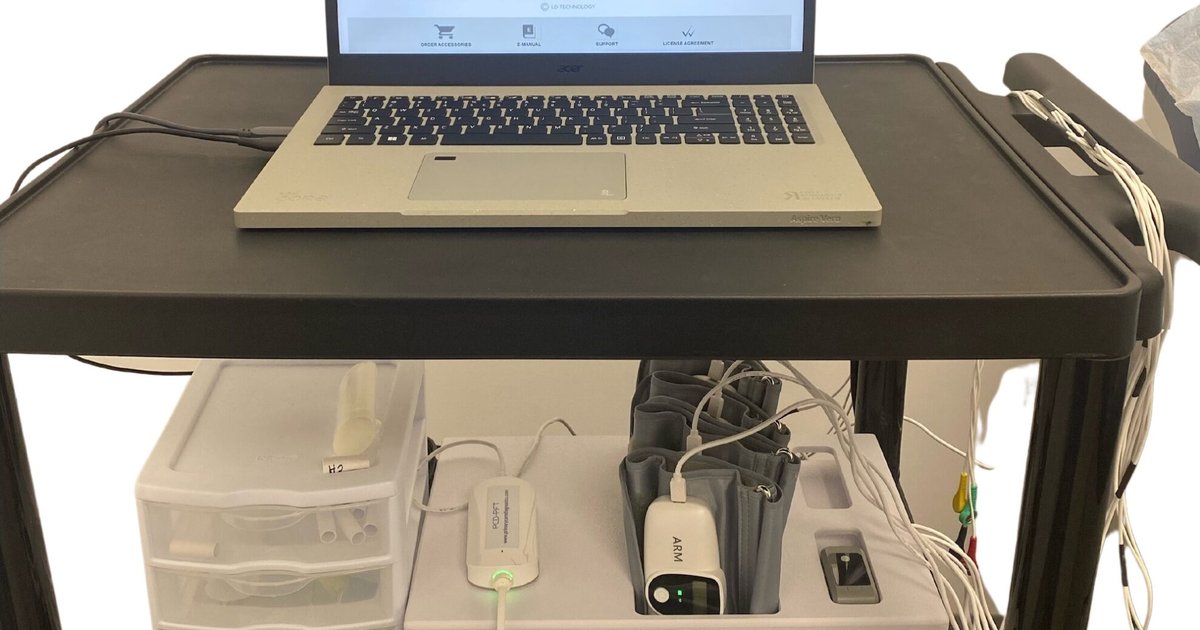
A point-of-care panel is designed to fit inside an existing appointment without slowing it down. A trained medical assistant or nurse places the cuffs and sensors, the system records the measurements in roughly 7 to 10 minutes, and the report is ready before the patient leaves. Nothing about it is invasive, so it slots in alongside vitals and lab draws.
The nephrologist reviews the results and decides what they mean for that patient: closer monitoring, foot protection, tighter risk-factor control, or a referral. Reports can be saved and shared to support the rest of the care team. For a closer look at the underlying measurements, see the overviews of autonomic nervous system testing and sudomotor testing.
How is this different from an EKG or a nerve conduction study?
This is a non-invasive point-of-care assessment system, not a diagnostic replacement. It is not a standard 12-lead EKG, and it is not a nerve conduction study or EMG. It does not assess kidney function and does not replace renal labs, duplex ultrasound, angiography, or a specialist evaluation. What it provides is objective, structured test data that helps a nephrologist decide who needs further work-up and who can be monitored. Used this way, it complements existing diagnostics rather than competing with them. Vascular testing for nephrology practices is a way to gather objective data when symptoms or signs are documented, not a way to make a final diagnosis at the bedside.
How can a nephrology practice add vascular testing?
Adding vascular testing for nephrology practices is meant to be straightforward. The CMAT Advantage system is sold as a package that includes the device, staff training, implementation help, and ongoing support, so a clinic is not left to figure out the workflow alone. The CMAT Advantage is built on FDA-cleared component devices, and HealthWright Technologies works only with the practice, not with patients directly.
If your kidney patients would benefit from objective vascular and autonomic testing, HealthWright Technologies can walk your team through what it looks like in a real clinic. Learn more on the partnership page or reach out through the contact page. You can also email contact@healthwrighttechnologies.com or call (678) 322-7146. HealthWright Technologies is based at 60 Bear Creek Marina Road, Mansfield, GA 30055.
Frequently asked questions
What is vascular testing for nephrology practices?
It is non-invasive, in-office testing that measures blood flow and autonomic nerve function in kidney patients, typically capturing the ankle-brachial index, toe-brachial index, heart rate variability, and sudomotor responses in a single 7-to-10-minute session so the nephrologist has objective data to act on.
Why is the ankle-brachial index unreliable in dialysis patients?
Advanced kidney disease causes medial arterial calcification, which stiffens ankle arteries so they resist compression. That can push the ABI to a falsely normal or high value and hide real disease. The toe-brachial index is the recommended fallback because toe arteries are far less affected by calcification.
Can in-office testing replace a nerve conduction study or angiography?
No. It is a point-of-care assessment tool, not a diagnostic replacement. It does not substitute for nerve conduction studies, duplex ultrasound, angiography, or renal function testing. It flags patients who may need further evaluation and supports, rather than replaces, a physician’s judgment.
How long does in-office vascular testing take?
A full panel usually takes about 7 to 10 minutes. It is non-invasive, uses blood-pressure cuffs and surface sensors, and can be run by a trained staff member during a routine appointment.
Is the CMAT Advantage built on FDA-cleared technology?
Yes. The CMAT Advantage runs on FDA-cleared component devices and is used as a non-invasive testing system. It is sold to physician practices with training, implementation, and ongoing support, and HealthWright Technologies works with the practice rather than treating patients directly.
This article is for educational purposes and is not medical advice. Vascular and autonomic testing supports clinical evaluation and does not replace a physician’s judgment, definitive diagnostic testing, or specialist referral. Consult a qualified healthcare provider for diagnosis and treatment. CPT® is a registered trademark of the American Medical Association. Coverage and reimbursement depend on payer policy and medical necessity and are never guaranteed.
Ready to see the CMAT Advantage in your practice?
Book a free 25-minute demo: see the full PAD + autonomic workup and how the three established CPT codes apply, with no obligation. Backed by our 60-day buyback guarantee.
Book a Free Demo →