Cervical orthosis HCPCS codes run from a soft foam collar that a patient can put on at home to a rigid multiple-post brace with chin and occipital supports, and the code that fits a given cervical collar depends far less on the brand on the box than on how the collar is built: how rigid it is, how it holds the head, and how far down the chest it reaches. The range sits between L0120 and L0200, and reading it by construction is faster than memorizing numbers.
There is one more thing worth knowing up front, because practices moving into neck bracing often assume it works like back bracing: cervical collar codes are not on the Medicare prior-authorization list the way several lumbar and knee codes are, and there is no cervical-collar-specific national coverage policy to read. That does not make the claim casual. A standard written order and a chart that supports medical necessity still decide whether a cervical collar is paid.
This guide walks through the cervical collar codes an in-office practice actually uses, what separates them, how the Medicare rules differ from the back-brace rules many practices already know, and how the collars a supplier carries line up against the codes.
HealthWright Technologies supplies prefabricated cervical collars to provider practices, and every product in that catalogue lists the supplier’s HCPCS reference on its page. Reading those references together is a starting point a generic coding article cannot give you. Across the cervical line the references land on three codes: the flexible foam collars reference L0120, the two-piece semi-rigid collar with a chin and thoracic piece references L0174, and the adjustable multiple-post orthoses reference L0180. A catalogue reference points you to the likely code. It does not pick the final code for your claim, because that choice is driven by the collar’s construction and by what your office documents at the fitting.
The decision behind the cervical codes
Before you look at a single code number, settle one question about the collar in front of you: how much does it control the neck, and how does it do it? The HCPCS Level II code set, which the Centers for Medicare and Medicaid Services maintains, sorts cervical orthoses along a ladder of rigidity, and the features that move a collar up that ladder are the ones you can see and feel.
- Rigidity. A flexible foam collar limits motion gently. A semi-rigid collar with a molded plastic shell holds the neck more firmly. A rigid multiple-post collar with metal or plastic uprights controls it the most.
- Chin and occipital support. A simple foam band wraps the neck. The firmer collars add a molded chin cup and an occipital piece that cradles the back of the head, and that support is part of what separates the higher codes.
- Thoracic extension. Some collars stop at the neck. Others add a piece that reaches down onto the chest to steady the head on the trunk, and that extension changes the code.
- How it is fitted. Most cervical collars are prefabricated and adjusted at the time of fitting. A few codes describe a collar molded to the individual patient, which is a different, and less common, service in an office setting.
Work from the collar to the code, not from the catalogue number back. Read the rigidity first, then the chin and occipital support, then whether it reaches the chest.
Cervical orthosis HCPCS codes, by construction
The codes sort into four construction families: flexible foam, semi-rigid adjustable, two-piece, and rigid multiple-post. The control gets firmer as you move down that order, and so does the code.
Flexible foam collars: L0120 and L0130
L0120 is the soft foam collar most people picture when they hear “neck brace.” It is flexible, non-adjustable, prefabricated, and furnished off the shelf, so it needs no special expertise to fit. It gives a comfort-level reminder to limit motion rather than firm control. Its close relative L0130 describes a flexible thermoplastic collar molded to the individual patient, a custom service that is uncommon in a general office. For the ready-made foam collar you dispense and adjust at the visit, L0120 is the code.

Semi-rigid adjustable collars: L0140, L0150, and L0160
Add a firmer shell and adjustability and the collar moves into the semi-rigid family. L0140 is a semi-rigid, adjustable collar, typically a plastic collar without a separate molded chin piece. L0150 adds a molded chin cup, the adjustable plastic collar with the chin and occipital support that steadies the jaw and the back of the head. L0160 describes a semi-rigid collar whose occipital and mandibular support comes from a wire frame rather than a solid molded piece. All three are prefabricated and adjusted at fitting. The tell among them is where the support comes from: no molded chin piece, a molded chin cup, or a wire-frame support.
Two-piece semi-rigid collars: L0172 and L0174
The two-piece collars are built from a front and a back half of semi-rigid thermoplastic foam that fasten together around the neck, which is what you see on many hospital and post-injury collars. L0172 is the two-piece semi-rigid thermoplastic foam collar. L0174 is the same two-piece collar with a thoracic extension, the added piece that reaches down onto the chest for more control of the head on the trunk. Both are prefabricated and furnished off the shelf. If the collar is two pieces and stops at the neck it is L0172; if it adds the chest extension it is L0174.

Rigid multiple-post collars: L0180, L0190, and L0200
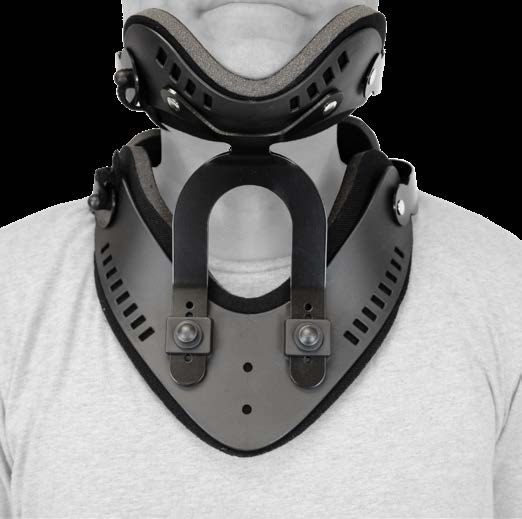
The most controlling cervical orthoses use adjustable posts between the chin and occipital pieces and the chest, which is how they hold the head rigidly. L0180 is the multiple-post collar with occipital and mandibular supports that adjust, and it is the code HealthWright Technologies carries most across its cervical orthosis line. L0190 adds adjustable cervical bars, the SOMI, Guilford and Taylor style designs that extend the control further. L0200 is that same adjustable-bar collar with a thoracic extension onto the chest. One more code sits beside this family: L0170, a cervical collar molded to the individual patient, which like L0130 is a custom service rather than a ready-made brace.
Read the construction here, not the number. Adjustable posts put a collar in the L0180 range, cervical bars move it to L0190, and a chest extension on those bars takes it to L0200.
Written orders and why cervical collars are not on the prior-authorization list
This is where neck bracing and back bracing part ways, and the difference matters if your office already dispenses lumbar braces. Several lumbar-sacral and knee codes, L0648 and L0650 among them, sit on the CMS Required Prior Authorization List, so for a Medicare beneficiary the supplier has to request a decision before the brace is delivered. The cervical orthosis HCPCS codes do not appear on that list.
There is also no cervical-collar equivalent of the spinal orthoses coverage policy that governs back braces, so you will not find a single national coverage determination that lays out exactly when a neck collar is covered.
That absence is not a shortcut. Every durable medical equipment claim, a cervical collar included, still needs a standard written order communicated to the supplier before the claim goes out, a documented reason the item is medically necessary, and proof that the patient received it. The CMS prior-authorization and documentation rules for DMEPOS are the reference for what the supplier owes on the claim. Because coverage follows the general benefit rather than a collar-specific policy, confirm the current order and documentation requirements with your own durable medical equipment Medicare administrative contractor before you bill, since those requirements are updated over time.
Documentation that supports the code you bill
The code is only as defensible as the chart behind it. A clean record generally shows the ordering provider’s documented reason the collar is needed, the specific diagnosis and the neck as the body region, the date the collar was provided, and enough detail about the collar itself to support the code.
For the firmer codes that detail matters. A note that the patient received an adjustable multiple-post collar with chin and occipital supports reads very differently from a note that says only “neck brace,” and the code should match the collar the chart describes.
None of this is a guarantee of payment. A HCPCS code is a description, not a coverage decision, and whether a cervical collar is paid depends on the patient’s documented medical necessity and the specific payer’s policy. Medicare applies its durable medical equipment rules; commercial payers set their own. HealthWright Technologies supplies the collars; the dispensing provider selects the code, fits the collar, documents the encounter, and submits the claim.
Code it to describe what you provided. Payment follows the policy, not the code.
How a supplier catalogue maps to these codes
Seeing real collars against the codes makes the families concrete. HealthWright Technologies carries prefabricated cervical collars, and each product page lists the supplier’s HCPCS reference. The mapping across the line looks like this:
- The ISO Preferred Foam Cervical Collar Wrap and the Comfortland Foam Cervical Collar reference the flexible foam code L0120.
- The ISO Preferred Immobilizing Chin and Cervical Collar references the two-piece-with-thoracic-extension code L0174.
- The DR Medical Cervical Orthosis, the ISO Preferred Cervical Collar, and the Comfortland ComfortMax Elite Cervical Orthosis reference the adjustable multiple-post code L0180.

A catalogue reference is the likely code, not a ruling. The construction of the collar and the way it is fitted and documented in your office decide the final code. For the full range beyond the neck, our HCPCS code guide for orthotic braces walks through the other body regions the same way, and the spinal orthosis code guide covers the back braces whose prior-authorization rules differ from the neck codes here.
Mistakes that cost cervical collar claims
- Coding up from the collar you actually dispensed. A soft foam collar is L0120. Billing a semi-rigid or multiple-post code for it because the higher code pays more is exactly the mismatch a payer looks for.
- Missing the thoracic extension, or inventing one. The chest extension is what separates L0172 from L0174, and L0190 from L0200. Code what the collar has, not what it might have had.
- Assuming the back-brace rules apply. Cervical codes are not on the prior-authorization list and have no collar-specific coverage policy, but the standard written order and documentation still apply. Treating the claim as automatic because there is no prior authorization is its own error.
- Billing a custom-molded code for a ready-made collar. L0130 and L0170 describe a collar molded to the individual patient. A prefabricated collar you adjusted at the visit is not one of those codes.
- Thin documentation. No ordering reason, no description of the collar, no diagnosis link. The code can be right and the claim still fails because the chart does not support it.
Frequently asked questions
What is the HCPCS code for a cervical collar?
There is no single cervical collar code. A soft, flexible foam collar is L0120. A semi-rigid adjustable collar is L0140, or L0150 when it has a molded chin cup, or L0160 when a wire frame provides the support. A two-piece semi-rigid collar is L0172, or L0174 when it adds a thoracic extension. A rigid multiple-post collar is L0180, L0190 with adjustable cervical bars, or L0200 when those bars carry a chest extension. Which code applies depends on the collar’s rigidity and construction.
Is L0174 or L0180 on the Medicare prior-authorization list?
No. The cervical collar codes are not on the CMS Required Prior Authorization List, which for orthoses covers certain lumbar-sacral, knee, and ankle-foot codes rather than neck collars. A standard written order and documentation supporting medical necessity are still required before the claim is billed, so confirm the current requirements with your durable medical equipment Medicare administrative contractor.
What is the difference between L0172 and L0174?
Both are two-piece semi-rigid thermoplastic foam cervical collars. L0174 adds a thoracic extension, the piece that reaches down onto the chest to steady the head on the trunk. If the two-piece collar stops at the neck it is L0172; if it has the chest extension it is L0174.
Does a supplier’s HCPCS reference guarantee the collar is covered?
No. A catalogue reference points you to the likely code, but coverage and payment depend on the patient’s documented medical necessity and the specific payer’s policy. The billing provider owns the final code and the claim.
HealthWright Technologies carries prefabricated cervical collars, including the ISO Preferred Immobilizing Chin and Cervical Collar and the Comfortland ComfortMax Elite Cervical Orthosis, alongside the rest of our DME bracing catalogue, and the line is available to approved provider accounts. If in-clinic bracing is new to your practice, our walking boot HCPCS code guide, our wrist and hand orthosis code guide, and our knee orthosis code guide cover the neighboring code families. Carrying a bracing line is a practice-management decision as much as a coding one, and our affiliate Practice Management Consultancy works with independent practices on that kind of operational planning. To set up access you can request a provider account or reach us through our contact page, and you can also call (678) 322-7146 and we will follow up.
This article is general coding and billing education, not coding advice for a specific claim or a guarantee of payment. HCPCS Level II codes are maintained by the Centers for Medicare and Medicaid Services. Code selection, documentation, and billing are the responsibility of the dispensing provider and must reflect each patient’s documented, medically necessary findings and the applicable payer coverage policy.
Ready to see the CMAT Advantage in your practice?
Book a free 25-minute demo: see the full PAD + autonomic workup and how the three established CPT codes apply, with no obligation. Backed by our 60-day buyback guarantee.
Book a Free Demo →