
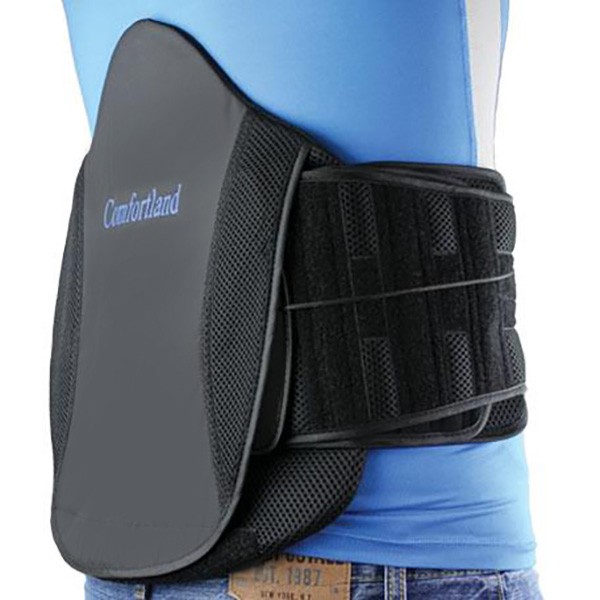
Spinal orthosis HCPCS codes cover everything from a flexible elastic lumbar belt to a rigid thoracolumbar brace with shoulder straps, and the code that fits a given back brace depends far less on the brand on the box than on two things: how the brace is built, and how much work it took to fit it to the patient.
Most of the market will tell you a back brace is “an L-code” and move on. That is where the claims go wrong. Nearly every lumbar-sacral category splits into a custom-fit version and an off-the-shelf version of the same product, and the one you bill is decided by the brace’s construction and by what happens at the fitting, not by the catalogue number alone.
This guide walks through the lumbar-sacral and thoracolumbar codes an in-office practice actually uses, what separates the paired codes, and how the back braces a supplier carries line up against them.
HealthWright Technologies supplies prefabricated back braces to provider practices, and every product in that catalogue lists the supplier’s HCPCS reference on its page. Reading those references together is a starting point a generic coding article cannot give you: the lumbar-sacral line carries the custom-fit codes L0627, L0630, L0631, L0633, L0637, L0639, the single code L0635, and their off-the-shelf partners L0642, L0643, L0648, L0649, L0650, L0651, with thoracolumbar braces coded L0454, L0455, L0456, and L0457. A catalogue reference points you to the likely code. It does not pick the final code for your claim, because that choice is driven by the brace’s design and by the fitting work your office documents.
The decision behind most of these codes
For most of the lumbar-sacral categories, before you look at a single code number, settle one question: was the brace off-the-shelf, or custom fit? The HCPCS Level II code set, which the Centers for Medicare and Medicaid Services maintains, defines the two the same way across the whole orthotic range.
- Off-the-shelf (OTS). The brace needs only minimal self-adjustment at the time of fitting. Someone without specialized orthotic training, the patient, a caregiver, or the supplier, can adjust the straps or trim it for comfort and the brace fits.
- Custom fit (prefabricated). The same manufactured brace, but it needed more than minimal adjustment to fit this patient, trimming, bending, molding, or assembling by someone with the expertise to do it. CMS describes these codes as a prefabricated item customized to fit a specific patient by an individual with that expertise.
For the paired categories there is no physical difference in the product. The same rigid lumbar brace can be billed off-the-shelf for one patient and custom fit for another. The code follows the service at fitting, so the note has to show the work. That is the single most common reason a back-brace claim is coded wrong, and it is why two codes exist for most of the categories below.
Spinal orthosis HCPCS codes, by construction
The lumbar-sacral codes sort into a handful of construction families. Within most families, one code is the custom-fit version and one is the off-the-shelf version. Reading them by construction is faster than memorizing numbers, because the construction is what you can see and the fitting is what you document.
Work from the brace to the code, not from the catalogue number back.
Sagittal control, rigid posterior panel: L0630 and L0643
Sagittal control means the brace limits forward-and-back bending. When that control comes from a rigid posterior panel with no rigid front, the pair is L0630 for the custom-fit version and L0643 for the off-the-shelf version. The posterior panel runs from the sacrococcygeal junction up to the T-9 vertebra and produces intracavitary pressure that offloads the lumbar discs. A ready-made panel brace that needs only a strap adjustment is L0643; one that a trained fitter has to trim or mold to the patient is L0630.
Sagittal control, rigid front and back panels: L0627, L0642, L0631, and L0648
Add a rigid anterior panel to the rigid posterior panel and the brace moves into the anterior-posterior sagittal family. Height decides which pair you are in. When the posterior panel runs from L-1 to just below L-5, the shorter brace, the pair is L0627 (custom fit) and L0642 (off-the-shelf). When the posterior panel runs higher, from the sacrococcygeal junction to T-9, the pair is L0631 (custom fit) and L0648 (off-the-shelf). Both produce intracavitary pressure. The taller codes carry extra steps, covered further down.
Height is the tell here. Measure where the posterior panel ends.

Sagittal-coronal control, rigid posterior frame: L0633 and L0649
Sagittal-coronal control adds side-to-side limitation to the front-and-back control. When that control comes from a rigid posterior frame braced by rigid lateral panels, with no rigid anterior frame, the pair is L0633 (custom fit) and L0649 (off-the-shelf). The posterior frame runs to the T-9 vertebra. The quickest way to separate this family from the posterior-panel family above is the lateral strength: a rigid side frame, not just a back panel.
Sagittal-coronal control, rigid front and back frame: L0637 and L0650
When the sagittal-coronal brace has a rigid anterior frame as well as a rigid posterior frame, with lateral strength from rigid side frames and intracavitary pressure to reduce disc load, the pair is L0637 (custom fit) and L0650 (off-the-shelf). This is the heavier contoured brace many practices picture when they say “rigid back brace,” and L0650 is one of the most frequently dispensed off-the-shelf lumbar-sacral codes.

Sagittal-coronal control, rigid shells: L0639 and L0651
The most enclosing lumbar-sacral braces use overlapping rigid shells rather than separate panels. The posterior shell runs to T-9 and the anterior shell from the symphysis pubis to the xyphoid, so the brace wraps most of the trunk and its strength comes from the overlapping rigid material and the closures that hold it. The pair is L0639 (custom fit) and L0651 (off-the-shelf). If you can see two rigid shells that overlap rather than discrete panels, you are in this family rather than the frame family above.

The lumbar flexion design: L0635
L0635 is the odd one in the lumbar-sacral set. It describes a sagittal-coronal brace with a rigid posterior frame and rigid lateral frames that also uses a lateral articulating design to flex the lumbar spine, and it is a single off-the-shelf code rather than half of a pair; its custom-fabricated counterpart is L0636. Read the construction here, not the number: an articulating flexion mechanism, not just rigid panels, is what puts a brace in L0635.
TLSO codes for braces that reach the thoracic spine
A thoracolumbar-sacral orthosis, or TLSO, is a back brace that extends higher than a lumbar-sacral brace, up toward the scapula, usually with a taller posterior panel and shoulder straps. The flexible TLSO that pairs a rigid posterior panel with a soft anterior apron is coded L0456 (custom fit) and L0457 (off-the-shelf), and a related flexible trunk-support configuration is coded L0454 (custom fit) and L0455 (off-the-shelf). The same custom-versus-off-the-shelf logic applies: the shoulder straps and the taller panel do not change how the fitting decision is made, only how far up the back the brace reaches.

Prior authorization and PDAC verification on the common codes
The most frequently used back-brace codes carry extra steps that a practice new to bracing often misses. L0648 and L0650 both sit on the CMS Required Prior Authorization List, as do L0631, L0637, L0639 and L0651, so for a Medicare beneficiary a decision has to be requested from the DME MAC before the brace is delivered. L0648 and L0650 also require coding verification from the Pricing, Data Analysis and Coding contractor, or PDAC: only a brace whose model PDAC has verified against the code’s description may be billed under that code, and these codes require a face-to-face encounter and a written order before delivery. The Medicare spinal orthoses coverage policy (LCD L33790) is the governing reference. None of this is coding trivia; a correct code on a claim that skipped a required prior authorization is still denied.
Documentation that supports the code you bill
The code is only as defensible as the chart behind it. Because off-the-shelf and custom fit share a product in most lumbar-sacral families, the chart is what tells a payer which code was billed. A clean record generally shows the ordering provider’s documented reason the brace is needed, the specific diagnosis and body region, the date the brace was provided, and, when a custom-fit code is billed, who did the fitting work and exactly what that work was. If a staff member only adjusted straps on a ready-made brace, the chart should read that way and the off-the-shelf code should follow.
None of this is a guarantee of payment. A HCPCS code is a description, not a coverage decision, and whether a back brace is paid depends on the patient’s documented medical necessity and the specific payer’s policy. Medicare applies its own durable medical equipment rules through the spinal orthoses coverage policy, and commercial payers set their own. HealthWright Technologies supplies the braces; the dispensing provider selects the code, fits the brace, documents the encounter, and submits the claim.
Code it to describe what you did. Payment follows the policy, not the code.
How a supplier catalogue maps to these codes
Seeing real braces against the codes makes the families concrete. HealthWright Technologies carries prefabricated back braces, and each product page lists the supplier’s HCPCS reference. The mapping across the line looks like this:
- The ISO Preferred Lumbar Back Brace III references the sagittal-control posterior-panel pair L0630 and L0643.
- The ISO Preferred Lumbar Back Brace V and the Comfortland Delta 31 LSO Back Brace reference the taller front-and-back pair L0631 and L0648.
- The Comfortland Delta 37 LSO Back Brace and the DR Medical The Solace LSO reference the sagittal-coronal front-and-back frame pair L0637 and L0650.
- The Comfortland Delta 39 LSO Back Brace and the TrendMed Extend LSO Back Brace reference the rigid-shell pair L0639 and L0651.
- The Ottobock Dyneva Back Orthosis references the lumbar flexion code L0635, and on the thoracolumbar side the Aspen TLSO 457 Back Brace references L0457.
Notice that a single product can reference both a custom-fit and an off-the-shelf code. That is not a contradiction; it is the catalogue telling you the code that applies depends on how the brace is fitted in your office. For the full range beyond the back, our HCPCS code guide for orthotic braces walks through knee, wrist, and ankle codes the same way.
Mistakes that cost back-brace claims
- Billing custom fit for an off-the-shelf fitting. If the only “fitting” was strap adjustment on a ready-made brace, the off-the-shelf code is the correct one, and the higher custom-fit code is a flag.
- Mismatching the construction. Posterior panel only, front-and-back panels, rigid frame with lateral strength, and overlapping shells are four different families. Read the brace, then pick the family, then settle off-the-shelf versus custom fit.
- Missing a required step on L0648, L0650, or L0631. A correct code is still denied without the prior authorization, the PDAC-verified model, or the face-to-face and written order these codes require.
- Trusting the catalogue code blindly. A supplier reference is a convenience, not a ruling. The construction and the fitting in your office decide the code, and most products list both options for exactly that reason.
- Thin documentation. No ordering reason, no fitting detail, no diagnosis link. The code can be right and the claim still fails because the chart does not support it.
Frequently asked questions
What is the HCPCS code for a back brace?
There is no single back-brace code. A sagittal-control lumbar-sacral brace with a rigid posterior panel is L0630 or L0643; with rigid front and back panels it is L0627 or L0642 for the shorter version and L0631 or L0648 for the taller one. A sagittal-coronal brace is L0633 or L0649, L0637 or L0650, or L0639 or L0651 depending on construction. A thoracolumbar brace is usually L0454, L0455, L0456, or L0457. Which code in a pair applies depends on whether the brace was off-the-shelf or custom fit.
What is the difference between off-the-shelf and custom-fit back brace codes?
Off-the-shelf codes apply when the brace needs only minimal self-adjustment and no special expertise to fit. Custom-fit codes apply when someone with expertise has to trim, bend, mold, or assemble the same prefabricated brace to fit a specific patient. The product can be identical; the service at fitting decides the code.
Do L0648 and L0650 need prior authorization?
Both L0648 and L0650 are on the CMS Required Prior Authorization List, and both also require PDAC coding verification before they are billed to Medicare. For a Medicare beneficiary, request the prior-authorization decision from your DME MAC before delivering the brace, confirm the specific model is PDAC-verified for the code, and make sure the face-to-face encounter and written order are on file.
Does a supplier’s HCPCS reference guarantee the brace is covered?
No. A catalogue reference points you to the likely code, but coverage and payment depend on the patient’s documented medical necessity and the specific payer’s policy. The billing provider owns the final code and the claim.
HealthWright Technologies carries prefabricated back braces, including the ISO Preferred Lumbar Back Brace V and the Comfortland Delta 37 LSO Back Brace, alongside the rest of our DME bracing catalogue, and the line is available to approved provider accounts. If in-clinic bracing is new to your practice, our guide to in-office bracing for physician practices, our walking boot HCPCS code guide, our wrist and hand orthosis code guide, and our knee orthosis code guide cover the workflow and the neighboring code families. Carrying a bracing line is a practice-management decision as much as a coding one, and our affiliate Practice Management Consultancy works with independent practices on that kind of operational planning. To set up access you can request a provider account or reach us through our contact page, and you can also call (678) 322-7146 and we will follow up.
This article is general coding and billing education, not coding advice for a specific claim or a guarantee of payment. HCPCS Level II codes are maintained by the Centers for Medicare and Medicaid Services. Code selection, documentation, and billing are the responsibility of the dispensing provider and must reflect each patient’s documented, medically necessary findings and the applicable payer coverage policy.
Ready to see the CMAT Advantage in your practice?
Book a free 25-minute demo: see the full PAD + autonomic workup and how the three established CPT codes apply, with no obligation. Backed by our 60-day buyback guarantee.
Book a Free Demo →


