

Electrotherapy for chronic pain management is the clinical use of controlled electrical current, delivered through electrodes placed on the skin, to influence pain signaling and to stimulate muscle. In an independent practice it is a non-pharmacologic option that trained clinical staff can deliver in a treatment room, in a fixed appointment slot, with no controlled substance involved. It is also a device category with a wide quality range, a long contraindication list, and an evidence base that honest clinicians describe as uncertain rather than settled.
This guide is written for physicians and practice managers who are evaluating the category rather than for patients. It covers what the modalities actually are, how they differ at the level of the current itself, what the published evidence supports and what it does not, which patients must be excluded, and what adding the service realistically demands of a practice. Where a specification is quoted, it comes from the manufacturer’s own operator manual rather than from a marketing sheet.

What is electrotherapy for chronic pain management?
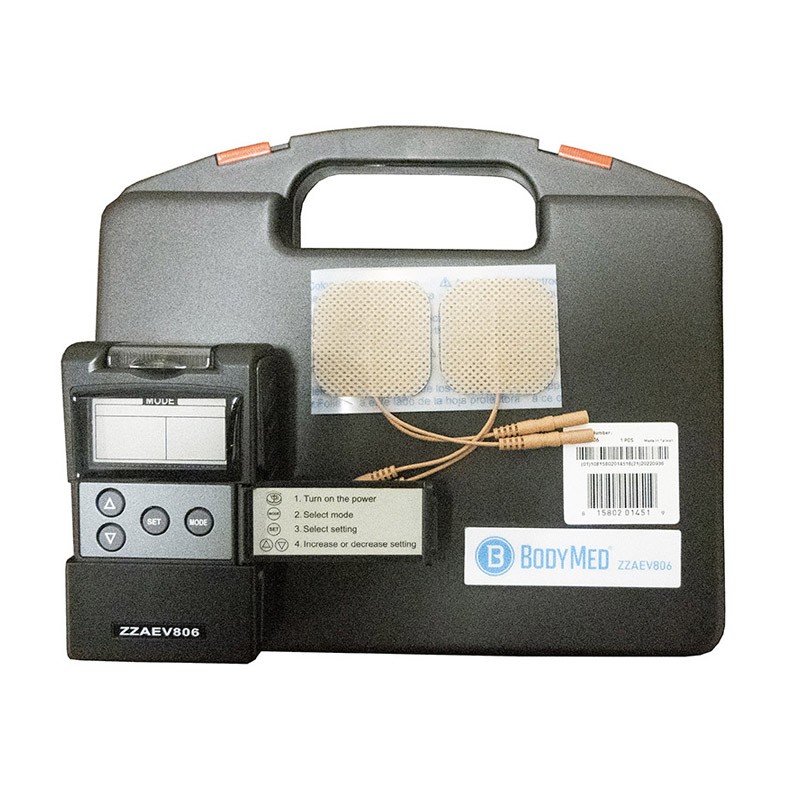
The term covers any device that passes a therapeutic electrical current across tissue through surface electrodes. In pain care the two broad families are transcutaneous electrical nerve stimulation, usually shortened to TENS, and interferential current devices, which include the Horizontal Therapy systems used in some pain and neuropathy practices. Electrical muscle stimulation overlaps with both, since most units carry muscle stimulation indications alongside pain indications. For a wider look at the full set of non-drug options for neuropathy pain a practice can offer, see our related guide.
Practically, electrotherapy for chronic pain management sits in the same part of a treatment plan as physical therapy and topical agents. It is an adjunct. The clearest framing for a practice is that it gives you something structured to offer a patient with persistent musculoskeletal or neuropathic symptoms between medication decisions, rather than something that replaces a diagnostic workup or a specialist referral. Our broader survey of non-opioid pain management options for independent practices puts the category alongside the other six approaches most practices consider.
One point matters before any of the rest. These are prescription devices. The Hako-Med PRO ElecDT HT Regenerator user guide states plainly, in its warnings section, that “Federal law restricts the sale, distribution, or use of this unit to, by, or on the lawful order of a licensed practitioner.” HealthWright Technologies sells electrotherapy systems to licensed practices and physicians only. We do not sell a device directly to a patient, and a patient who wants one is referred back through their own physician.
How do TENS and Horizontal Therapy actually differ?
Most comparison articles stop at “TENS is portable and clinic systems are stronger,” which tells a buyer nothing. The real difference is the carrier frequency of the current, and it is large enough that the two are not interchangeable devices with different price tags.
Conventional TENS units operate in the low frequency range, roughly 2 to 150 Hz. The Hako-Med PRO ElecDT HT Regenerator operates several orders of magnitude higher. Its technical data page specifies “sinusoidal alternating current” that is “frequency-modulated with a frequency of 4000Hz to 12000HZ,” and it lists that same 4,000 to 12,000 Hz modulated range separately for each of its four treatment programs, named HT, HT+, P and W. Higher carrier frequencies encounter lower skin impedance, which is the stated rationale for the design.
| Attribute | Conventional TENS | Hako-Med PRO ElecDT HT Regenerator |
|---|---|---|
| Typical carrier frequency | About 2 to 150 Hz | 4,000 to 12,000 Hz, frequency-modulated |
| Current form | Pulsed | Sinusoidal alternating current |
| Programs | Varies by unit | Four: HT, HT+, P and W |
| Session length | Set by the operator | Fixed at 30 minutes |
| Setting | Portable, often issued for home use | In-office system operated by trained staff |
| Regulatory class | Class II | “Classification: FDA Class II Device” per the user guide |
Two details in that table change how the service gets scheduled. The treatment time on the Hako-Med system is not adjustable. Its manual states that “the treatment time is always set to 30 minutes and will start to count down when the intensity is increased for the first time.”
That fixed half hour is what your front desk is actually booking. Because the device is an in-office system rather than a take-home unit, the revenue and the staffing both sit inside the practice. That is a different operational model from writing a patient a portable TENS unit and sending them home with it.
The user guide also places the device in the interferential family in its own safety language, noting that “the safety of interferential current units for use during pregnancy or delivery has not been established.” That is the manufacturer’s wording, and it is the correct basis for how the device is described. Full product detail sits on our Hako-Med electrotherapy systems page.
What does the evidence say about electrotherapy for chronic pain management?
This is the section most vendor material skips, and skipping it is a mistake, because a physician will ask.
Start with the size of the problem. Chronic pain is common and expensive. Using 2023 National Health Interview Survey data, the Centers for Disease Control and Prevention reported in MMWR QuickStats that 25.4 percent of women and 23.2 percent of men had chronic pain in the past three months. The companion NCHS Data Brief No. 518 by Lucas and Sohi puts the overall adult figure at 24.3 percent, with 8.5 percent reporting high-impact chronic pain that frequently limited life or work activities. Guy and colleagues, writing in Medical Care in 2025, put the total economic cost of chronic pain in the United States at 722.8 billion dollars for 2021, of which 192.2 billion was lost work productivity.
Those figures explain why patients keep asking for something other than a prescription. On their own they do not justify buying anything.
Guideline direction supports the general approach. The CDC Clinical Practice Guideline for Prescribing Opioids for Pain, 2022 advises clinicians to “maximize use of nonpharmacologic and nonopioid pharmacologic therapies as appropriate” for subacute and chronic pain, and states that “multiple noninvasive nonpharmacologic interventions are associated with improvements in pain, function, or both, that are sustained after treatment and are not associated with serious harms.”
The American College of Physicians reached a similar conclusion for chronic low back pain in 2017, giving a strong recommendation that clinicians and patients “initially select nonpharmacologic treatment.” One caveat belongs with that citation. The ACP list names exercise, rehabilitation, acupuncture and several mind-body therapies. It does not name electrical stimulation, so it should never be quoted as an endorsement of this category specifically.
Now the part that constrains what you may claim. A 2019 Cochrane overview of TENS for chronic pain by Gibson and colleagues concluded that although the methodological quality of the underlying reviews was good, “the quality of the evidence within them was very low.”
The authors were “unable to conclude with any confidence that, in people with chronic pain, TENS is harmful, or beneficial for pain control, disability, health-related quality of life, use of pain relieving medicines, or global impression of change.”
That is an honest starting point, not a reason to dismiss the category. Very low certainty means the trials were too small and too heterogeneous to settle the question, not that the therapy was tested and failed.
What it does mean is that any practice offering electrotherapy for chronic pain management should describe it to patients as an option that some people find helpful, with a favorable safety profile when contraindications are respected. It should not be described as proven, or as a replacement for anything. Marketing copy that overstates this is the fastest way to create a problem you did not need.
Which patients should not receive electrotherapy?
The exclusion list is the most clinically useful page in the manual and the one least likely to appear in a sales conversation. The Hako-Med PRO ElecDT HT Regenerator user guide lists ten contraindications.
They are thrombophlebitis, manifest thrombosis, a cardiac demand pacemaker, acute danger of hemorrhage, disturbances in cardiac rhythm, tetany where caution should be exercised in dosing, acute local inflammatory processes caused by bacterial or viral infection such as furuncle, phlegmon, herpes simplex or acute herpes zoster, stimulation over the carotid sinus, transcerebral stimulation, and use on cancer patients.
A separate warnings and precautions list adds eleven more items. Among them: safety in pregnancy or delivery has not been established, the long-term effects of chronic electrical stimulation are unknown, adequate precautions should be taken with persons who have suspected heart problems or suspected or diagnosed epilepsy, and the device should not be used over the menstruating uterus.
Build that list into your intake form rather than leaving it to the treating staff member to remember. A pacemaker question and a malignancy question belong on the same sheet the patient signs, and the operator should confirm both verbally before the first session.
What does a treatment session look like in the room?
Knowing the specification is not the same as knowing the workflow, and the workflow is what decides whether a new service survives its first busy month.
A session begins before the current does. The operator confirms the contraindication list against the chart, checks the skin at the intended electrode sites for breaks, rash or recent infection, and confirms nothing has changed since the last visit. A new pacemaker or a new cancer diagnosis between appointments is exactly the sort of thing that does not get volunteered unless somebody asks.
Electrodes go on according to the treatment plan and intensity is brought up gradually. On the Hako-Med system the thirty minute clock starts at that first increase, not when the patient sits down, so the room is occupied for meaningfully longer than the treatment time itself. Practices that plan a thirty minute slot tend to discover that forty five is closer to the truth once greeting, placement, removal and a skin check are counted.
Afterwards the note matters as much as the session. Record the program used, electrode placement, the intensity tolerated, the session duration, how the patient described the symptom before and after, and any skin finding. A run of sessions with no documented reassessment is a plan nobody can defend later, and it is also a plan nobody can tell is working.
How does electrotherapy fit alongside diagnostic testing?
Electrotherapy is a treatment, so it belongs downstream of a workup rather than in place of one. When a patient presents with symptoms of peripheral neuropathy, burning or numbness in the feet, or unexplained lower limb pain, the clinical question is what is driving the symptoms before anything is applied to the skin.
That is where in-office diagnostic testing and treatment connect in practice. Our note on small fiber neuropathy testing for physicians covers what the different fiber classes indicate and how sudomotor and vascular measures are read in symptomatic patients, and the CMAT Advantage system is the platform most of our partner practices use for that evaluation. Establishing a vascular or autonomic finding first also gives you something objective to document alongside a treatment plan, which matters when the plan is questioned later.
What does adding electrotherapy for chronic pain management require?
Four things, in rough order of how often practices underestimate them.
- Room time, not just a device. A fixed thirty minute session plus setup and electrode placement is a real block on the schedule. A practice running several sessions a day needs a dedicated space, not a corner of an exam room that is needed for something else.
- A trained operator and a written competency record. Electrode placement, intensity progression and the contraindication check are all operator-dependent. Our Hako-Med operator training program exists for this, and it produces a competency checklist and a certificate you can keep in a personnel file.
- A documented protocol. Who is a candidate, who is excluded, how many sessions before the plan is reassessed, and what gets recorded in the chart after each one. Without this, the service drifts and the notes will not support it.
- A clear-eyed financial model. Treat it the way you would any other in-office service line. Our overview of ancillary revenue for medical practices walks through how to think about room utilization and staffing before committing capital.
Note what is deliberately absent from that list: a promise about payer behavior. Coverage for electrotherapy varies by payer, by plan and by diagnosis, and any code selection and documentation is the treating practice’s responsibility. Confirm the position with your own contractor and payers before you build a financial model on it.
Frequently asked questions about electrotherapy for chronic pain management
Is electrotherapy for chronic pain management proven to work?
No. A 2019 Cochrane overview of TENS for chronic pain found the certainty of evidence very low and was unable to conclude with confidence that TENS is either beneficial or harmful for pain control, disability or quality of life. It should be presented to patients as an option some people find helpful, never as a proven or guaranteed result.
What is the difference between a TENS unit and a Horizontal Therapy system?
Carrier frequency, mainly. Conventional TENS runs roughly 2 to 150 Hz. The Hako-Med PRO ElecDT HT Regenerator user guide specifies a frequency-modulated sinusoidal current of 4,000 to 12,000 Hz across all four of its programs. TENS units are typically portable and often issued for home use, while the Hako-Med system is an in-office device operated by trained staff.
How long is a treatment session?
On the Hako-Med PRO ElecDT HT Regenerator the treatment time is fixed. The user guide states it is always set to 30 minutes and begins counting down when the intensity is first increased. Schedule setup and electrode placement on top of that.
Who cannot receive electrotherapy?
The manufacturer lists ten contraindications, including thrombophlebitis, manifest thrombosis, a cardiac demand pacemaker, acute danger of hemorrhage, disturbances in cardiac rhythm, acute local infection, stimulation over the carotid sinus, transcerebral stimulation and use on cancer patients. Separate precautions cover pregnancy, suspected heart problems and suspected or diagnosed epilepsy.
Can a patient buy an electrotherapy system directly?
Not from HealthWright Technologies. These are prescription devices, and the user guide carries the federal restriction limiting sale, distribution or use to or on the lawful order of a licensed practitioner. We sell to licensed practices and physicians only. A patient who is interested should raise it with their own physician, who can contact us directly.
Talking it through
If you are weighing electrotherapy for chronic pain management as an addition to your practice, the useful conversation is about your patient mix, your room capacity and who would run the sessions, not about the hardware. HealthWright Technologies has supported independent practices with diagnostic and therapeutic devices, training and implementation since 2000, and we would rather tell you the service is a poor fit for your schedule than sell you a system that sits in a closet. Reach us at contact@healthwrighttechnologies.com or through the contact page, and we will follow up. Our office is at 60 Bear Creek Marina Rd, Mansfield, GA 30055.
Medical disclaimer: This article is general information for healthcare professionals and is not medical advice. Consult your healthcare provider before starting any new treatment. Device specifications quoted here are taken from the manufacturer’s user guide and are attributed to the manufacturer. Coverage, code selection and documentation are the responsibility of the treating provider and are subject to payer policy.
Featured image: “Tens.jpg” by Yeza, via Wikimedia Commons, licensed under CC BY-SA 4.0.
Ready to see the CMAT Advantage in your practice?
Book a free 25-minute demo: see the full PAD + autonomic workup and how the three established CPT codes apply, with no obligation. Backed by our 60-day buyback guarantee.
Book a Free Demo →
