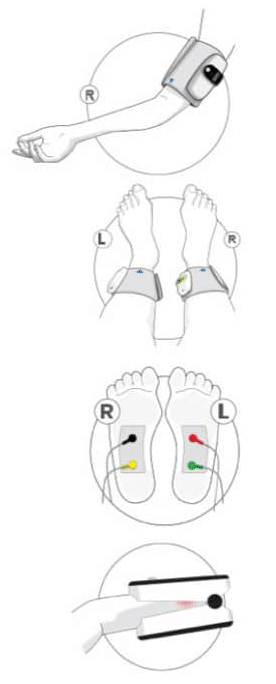
Every sudomotor reading is only as clean as the electrode that captures it. For independent practices running the CMAT Advantage™ system, disposable skin electrodes are the small consumable that quietly determines whether each test is consistent, sanitary, and easy to stand behind. Here’s what to know about CMAT Advantage electrodes: what they measure, why they’re single-use, and how to keep every exam room stocked.
1. What CMAT Advantage electrodes are used for
CMAT Advantage disposable skin electrodes make the skin contact the system uses to record galvanic skin response (GSR) during sudomotor testing. Sudomotor testing looks at how the small nerve fibers that regulate the sweat glands are working. Because those small fibers are often among the first affected in conditions like diabetes, the test gives clinicians an objective data point when they evaluate patients who present with symptoms of autonomic dysfunction, such as unexplained neuropathy symptoms in a patient with diabetes. The CMAT Advantage system is built on FDA-cleared component devices, and the electrode is the piece that actually captures the signal, so a clean, well-adhered electrode directly affects how reliable each reading is.
2. Why single-patient, single-session use matters
These electrodes are single-patient, single-session disposables, and using a fresh set every time protects two things at once. The first is accuracy: adhesive breaks down, conductive gel dries out, and a reused electrode can add noise or drift to a signal that depends on clean, consistent skin contact. The second is infection control: a new electrode per patient removes any cross-contact between people. Stretching a pack by reusing electrodes is a false economy. It risks the reliability of the reading, and your infection-control standards, to save a single disposable part.
3. What’s in each pack
- 120 disposable skin electrodes per pack
- Available on our store
- Single-patient, single-session use
- Roughly one set per patient session, about 60 sessions per pack
There is only ever one CMAT Advantage electrode to reorder, so restocking is simple.
4. Never run out with Subscribe & Save
Buying a pack at a time works, but most practices would rather not track it. With Subscribe & Save, electrodes arrive automatically every 1, 2, or 3 months at a standing discount off the one-time store price, and you can skip a delivery or cancel anytime. For a busy testing schedule, a standing order is the simplest way to make sure supplies are never the reason a test gets rescheduled.
5. Frequently asked questions
Are these electrodes compatible with the CMAT Advantage?
Yes. They are intended for use with the CMAT Advantage system for sudomotor testing.
Can I reuse electrodes between patients?
No. They are single-patient, single-session disposables; reuse is not recommended and can compromise both test accuracy and infection control.
How often should I reorder?
It depends on your testing volume. At roughly one set per session, a 120-count pack covers about 60 patient sessions, and Subscribe & Save lets you match delivery frequency to that pace automatically. For the wider workflow around that number, see our guide to medical practice supply inventory management.
Ready to restock? Order CMAT Advantage electrodes, see the full product details, or browse everything in the Supplies Shop.
Where the electrode sits in the CMAT Advantage test
It helps to know what else is happening while the electrode is on the patient. The CMAT Advantage autonomic sequence runs the Valsalva maneuver first, then paced deep breathing, then the standing phase, and the sudomotor measurement sits alongside that battery. The whole exam takes roughly 7 to 10 minutes. The system is on-premises, so the result is produced on the machine in your office and the report comes out as a PDF you can print or save to the chart the same day. Nothing leaves the building and nothing waits on an upload.
The practical consequence for supplies is that the electrode is a rate-limiting part. If the pack is empty, the sudomotor portion does not happen, and a partial exam is a scheduling problem rather than a clinical one. Testing should always follow documented symptoms or risk indications, and the results are there to inform clinical management. A missing consumable should never be the reason a medically necessary test gets moved.
Room conditions change the reading more than most staff expect
This is the part that is easiest to get wrong and hardest to see afterwards. LD Technology’s own measurement protocol for the sudomotor step specifies a room held between 73 and 75 degrees Fahrenheit. The stated reason, in LD’s result reading guidelines, is to avoid activating the sweat glands through heat or causing vasoconstriction through cold. A room that drifts warm or cold does not stop the test. It just quietly makes the measurement less comparable to the last one.
So treat the thermostat as part of the consumable workflow rather than as building maintenance. A room thermometer in the testing space, checked before the first patient, costs nothing and removes a variable that no amount of careful electrode placement can compensate for. Note the wider CMAT exam-room preparation list uses a slightly different range, because it covers the whole battery rather than the sudomotor step specifically. Match the figure to the step you are running.
Setting a par level from your own testing volume
Reordering by feel is what produces the emergency order. Reordering from arithmetic takes about five minutes and then never needs thinking about again. The pack maths on CMAT Advantage electrodes is unusually simple, because there is only one electrode SKU and roughly one set per patient session:
- A pack holds 120 disposable skin electrodes, which is about 60 patient sessions
- Count your sudomotor sessions over a representative four weeks, not a quiet week
- Divide by 60 to get packs per month, then round up rather than down
- Hold a reorder point of at least two weeks of sessions on the shelf
- Add a buffer if you run testing clinics in blocks rather than evenly across the week
A practice running 30 sessions a month gets about two months from a pack, so a standing delivery every second month with one spare pack in reserve is enough. A practice running 30 sessions a week is a different animal, closer to a pack every fortnight, and needs a shorter delivery cycle rather than a bigger single order. The general method behind this, including how to set par levels for every consumable in the practice rather than just this one, is in our guide to medical practice supply inventory management.
Who owns reordering, and what a stockout actually costs
Name one person. Supplies fail in practices where reordering is everybody’s job, because everybody assumes the last person who opened a box also ordered the next one. The owner does not need to be senior. They need to be the person who is reliably in the building and who touches the stock.
The cost of getting it wrong is worth stating plainly, because it is usually underestimated. A stockout does not cost the price of a pack. It costs the appointment slot, the staff time already spent bringing the patient in, the follow-up call to rebook, and a patient who now associates your testing programme with a wasted trip. Set against that, carrying one spare pack is trivially cheap insurance.
Receiving and storing a pack properly
Two habits prevent most of the remaining trouble. First, check the delivery against the order the day it arrives rather than the week it arrives, because a short shipment discovered three weeks later is no longer straightforward to resolve. Second, store packs somewhere with stable temperature and no direct sunlight, and rotate so the oldest pack is the one in use. Adhesive and conductive gel are the parts of a disposable electrode that age, and an electrode that has sat in a hot store room is exactly the one that will not adhere cleanly on the day you need it.
Keep opened packs closed between sessions rather than leaving a tray of loose electrodes out in the room. It protects the adhesive, and it also removes any ambiguity for staff about which pieces are still unused.
One last habit is worth building in from the start. Record which pack a session was run from, even informally, so that if a batch ever behaves oddly you can tell how many exams it touched rather than guessing. It costs a line in the log and it turns a vague worry into a bounded, answerable question. Practices that already log lot numbers for other supplies usually find the electrode fits into the same sheet without any new process at all.
Finally, keep the reorder decision separate from the budget conversation. The question of how many electrodes the practice needs is a function of testing volume and nothing else, and it should be answered by whoever tracks the schedule. Whether the practice buys a pack at a time or takes a standing delivery is a separate, commercial question. Practices that let the two questions merge end up setting a par level from what feels affordable this month rather than from how many patients they intend to test, and that is how a testing programme quietly starts declining appointments it could have run.
Disclaimer: This article is for informational purposes only and does not constitute medical advice. Always consult a qualified healthcare professional for diagnosis, treatment, and clinical decision-making.
Ready to see the CMAT Advantage in your practice?
Book a free 25-minute demo: see the full PAD + autonomic workup and how the three established CPT codes apply, with no obligation. Backed by our 60-day buyback guarantee.
Book a Free Demo →